Tuesday, November 25, 2014

Brazilian Tourist Blog – Part 4, Santarém and the Amazon River

The Santarém Cathedral as seen from the riverfront
We arrived in the Amazon in the middle of the afternoon.  As we approached the airport, we could see the huge milky brown channel of the Amazon River flowing below us, bordered by a the seemingly endless canopy of the rainforest.  We had left Belo Horizonte before sunrise but it is a long way to Santarém.  When we walked down the stairs from our airplane, a wave of equatorial humidity and heat hit us.  It was hot in Minas Gerais but it is even hotter in the Amazon jungle.  Santarém is an old (founded by Portuguese explorers in 1661) port city located just south of the equator at the confluence of the clear water Rio Tapajós and the silt laden Rio Amazonas.  Prior to Portuguese colonization, the Tapajós Indians, a successful and sophisticated agricultural tribe had inhabited the beautiful area for centuries.  My husband Jeff had already arrived and he picked us up at the airport.  We checked into our hotel and immediately put on swimsuits and jumped into the hotel’s large pool.  Jeff fell asleep on the chaise while I did my laps – I tried to sprint every other lap in the warm water to at least imagine I was getting some exercise.  After the hikes around Inhotim and the long trip from the south I was tired too.  I don’t think my sprints amounted to much more than a leg stretch but it felt great to swim.

The Asa Dourado II at its dock in Santarém
After our tours of Brazilian art and history, we were ready for the Amazon – the river and the jungle.  Soon after our arrival, we spent a bright sunny Sunday aboard an Amazon riverboat, the Asa Dourado II.  We arranged for a full day river excursion with a local company BigTreeAdventures, http://www.bigtreeadventuretours.com


ZIB welcomes us
I highly recommend this company to anyone traveling in the Santarém area.  They are experienced professionals who specialize in unique Amazon eco-adventures.  The folks at BigTreeAdventures are very knowledgeable and their trips are exceptional.  More importantly they are creative and just plain fun to be with.  BigTreeAdventures is an offshoot of a lumber company, Zero Impact Brazil (more about this company in my next blog).  We contacted them following a recommendation in Lonely Planet.  It turned out to be a great lead – in addition to the river excursion we spent a second day with them exploring the rainforest and the history of the region.  Our first meeting with our tour guide was great.  Karim, a pencil-thin, twenty-something Russian arrived at our hotel on our first morning.  He wanted to make sure everything was arranged to our satisfaction.  But he did not look like a forest ecologist at all – he looked like a Russian intellectual.  It turns out he might be both.  Karim moved to Santarém four years ago from Russia.  He was en route to French Guiana but like lots of travelers never got to the place he’d originally intended.  Instead, he took a side trip to Santarém, met his boss, Rick, an American expat who has lived in Santarém almost twenty-five years and stayed put.  Now Karim knows more about the rainforest and the history of Santarém than most people who were born there.  As one of his friends, a fellow who works for the Santarém Bureau of Tourism told us – “I hired a Russian guy (Karim) to explain the history of rubber farming in the Amazon to a group of Brazilian teachers and students who were visiting.  Why would I hire a Russian?  He knows more than anyone else.”  Karim speaks five or six languages, including flawless English and French.  He eats books as far as I can make out.  He never stops talking and it is not clear he ever sleeps.  He is a wonderful host.

We didn’t meet his boss Rick, the owner of the company until a couple of days later when we visited his sawmill and forest.  I will describe our river trip first in this blog and our forest adventure in the next blog.

Hand washing station on the Asa Dourado II
The Asa Dourado II is a traditional flat-bottomed Amazon riverboat with a partially covered upper deck and a full kitchen, a bathroom and other accommodations below.  The wheelhouse in front is enclosed allowing the boat to be driven safely regardless of the weather.  There isn’t a drought in the Amazon!  2014 saw the highest discharge (total amount of water flowing in the river) on record.  We left the dock in downtown Santarém late morning and motored west towards the Tapajós.  Along the waterfront we passed a huge warehouse and loading dock belonging to Cargill, the multinational agribusiness.  The facility is used to store and ship soy and corn – two crops that are increasingly covering land around Santarém that used to be rainforest.  

Cargill Facility in Santarém
Karim told us that when Cargill built the facility, it displaced the best and most heavily used public beach in town.  Unfortunately it is not only the rainforest that is lost when large-scale agriculture expands.  Soon we left the port behind and, after a pre-lunch snack of iscas de peixe, small pieces of fresh fried fish, we arrived at a remote white sandy beach.  The captain drove the boat up onto the sand, anchored it with an iron rod and rope, and set up a portable grill.  He gave me a big grin as he took the fresh tambaqui out of garlic, lime juice and herb marinade and placed it on the hot coals.  He definitely knew what he was doing. 
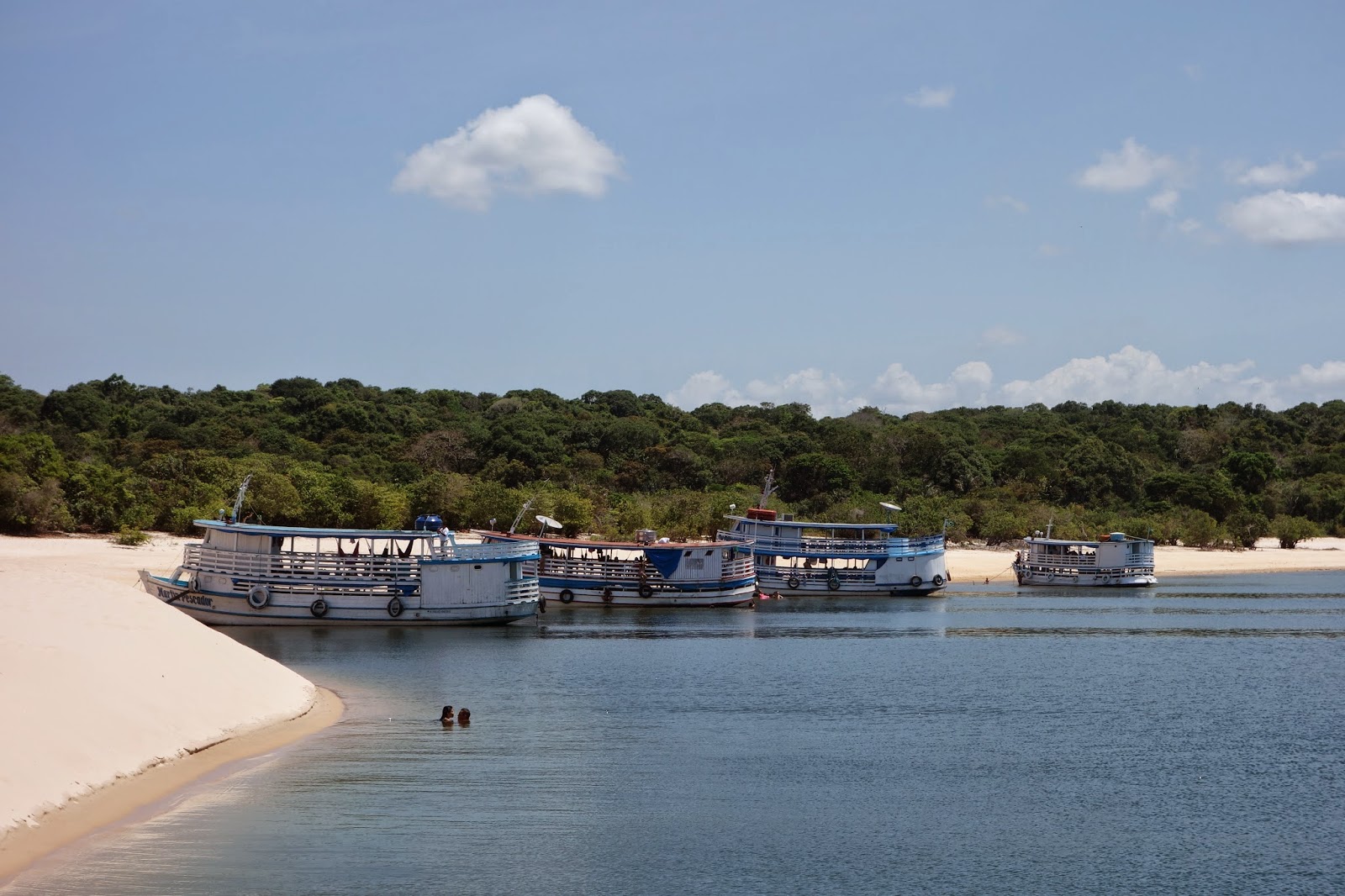
Sunday afternoon on the Tapajós River

While the fish grilled, Jeff and I walked down the beach, stretched our limbs with a few Yoga exercises (very important to remember to stretch when you are over sixty) and went for a relaxing swim in the soft water.  We passed other folks relaxing in the water on Sunday afternoon.  We got back just in time for lunch.  
The captain brings fresh grilled tambaqui on board!


After lunch we left the beach and drove to the confluence of the Tapajós and the Amazon – the Encontro das Águas or Meeting of the Waters.  There, fingers of café com leite-colored water and clear deep blue water intertwine, mixing together in endless eddies as they flow downstream together.  As we drew near the Amazon, Karim interviewed each of us, asking what our hopes about being on the biggest river in the world were.  I answered that my hope was to see a pink dolphin.  As if on cue, a large bright pink dolphin rose out of the waves in front of the boat.  The captain slowed and we all watched in awe as a school of dolphins swam playfully in and out of the mixing of the opaque brown and clear waters.  Karim joked that he had the botos on retainer – as much fresh fish as they wanted!

A small side channel or paraná on the Amazon River - our afternoon fishing spot
Later that afternoon we had a chance to go fishing ourselves – in a paraná (a small side channel to the main stem).  There as we deployed our fishing lines, we watched a herd of cows swim across the water.  Who knew cows could swim?  My brother-in-law caught a red-bellied piranha but I caught nothing – just a few bites. 


Setting nets along the river
Along the banks we saw small farms and fishermen’s houses, white egrets and a host of other pretty colored birds, swooping down from the trees and diving to catch fish in their long beaks.  We saw families and fishermen traveling in small boats, setting nets or bringing supplies back from town.  On the way back to the docks we munched freshly fried banana chips and drank strong sweet coffee out of little blue glass cups.  

All the while Karim regaled us with stories about the culture, the history, the politics and the ecology of the greater Santarém region.  As we disembarked and thanked our gracious captain, the cook and crew, Karim promised us an equally good adventure the next day in the forest.


Saturday, November 22, 2014

Brazilian Tourist Blog – Part 3, Inhotim


Saudade (nostalgia) for Inhotim at the Rio Botanical Garden
We left Ouro Preto and returned by bus to Belo Horizonte.  We had booked a hotel close to the bus station since we planned to spend the next two days traveling by bus to Inhotim – a unique venue that combines world-class botanical gardens with outstanding contemporary art.  It is located in the countryside west of Belo Horizonte.  There is only one public bus a day that goes to Inhotim.  It leaves the bus station every morning at 8:15 am and returns every afternoon, leaving Inhotim at 4:30 pm. The next day, after an early breakfast, we took a taxi to the bus station and discussed with the driver the safety of walking the distance (~1.6 km) in the evening.  The cabbie assured us that the short walk would be safe in the daylight.  For the rest of our visit we walked to and from the bus station.

Like the bus to Ouro Preto, the bus to Inhotim is comfortable and modern with reclining reserved seats and air conditioning.  The trip is long – it takes one hour and 45 minutes to travel one way.  Part of the time is spent just getting out of Belo Horizonte traveling through clogged roads bordered by seemingly endless commercial areas and sprawling suburbs.  Everything looked poor.  Many of the houses were made out of crude bricks and cement with no plaster or paint – reminiscent of the favelas (slums) around São Paulo; skinny horses grazed along the roadsides; even the commercial establishments looked as if they’d seen better times – empty parking lots and signs that were falling apart.  We saw closed restaurants and abandoned, derelict buildings.  We passed a series of paper recycling facilities where the workers appeared to be homeless people who slept on the pavement outside the metal shuttered doors.  Here and there a gated residential complex advertised a better life with pictures of brightly painted houses and trees and swimming pools.  Eventually we came to a more rural landscape – but it too was poor – dirt roads, small, impoverished farms, skinny cattle and unkempt patches of scrub forest.  We passed through the nearest small town, Brumadinho, itself looking somewhat depressed.  Then we arrived in a completely different world.  Even the Inhotim parking lot is smartly paved.  I was reminded again that Brazil is a country of extreme contrasts.

Inhotim is an extraordinary institution.  To call it a park is an understatement.  The place was first conceived by Minas Gerais businessman Bernardo de Mello Paz in the 1980’s and designed by the late great landscape architect Roberto Burle Marx.  It opened to the general public in 2006 and has significant collections of both contemporary art and botanical species from around the world.  I refer you to their website www.inhotim.org.br for more about the collections, the institution, its history and philosophy.  My blog records only my own personal impressions – all in words with no photographs.  Inhotim requests that all outdoor photographs be only for personal use.  No photographs are allowed inside the galleries.  In honoring this request, I must say that the combination of landscape and art at Inhotim is impressive.  The few photographs I include are from other places.  Hopefully my words will “paint a picture” of Inhotim and the interactions between its plants and art in all its forms!  Let me know!  I highly recommend a visit or, at minimum, perusal of Inhotim’s website.  Burle Marx’ landscape designs alone are stunning but when combined with the architecture of the pavilions, the winding paths and wooden benches set in shaded glades throughout the grounds, it is a brilliant space unlike anything I have ever seen before.  Paz keeps the park accessible to all by personally subsidizing its operations.  Inhotim supports multiple school and community programs (we saw many groups of school children during our visit) and the continuous development of knowledge in all its dimensions.

We entered Inhotim by following the first of many paved wide walkways.  We called them the red brick roads since the interlocking brick pavers are a light terra cotta color.  The first path led to the reception area where we bought our tickets and received a map.  The map is excellent and includes an accurate schematic of all the paths, numbered art installations and galleries as well as the important botanical plantings, restaurants, snack bars, bathrooms and lakes.  The park is divided into three areas that are color coded (pink, yellow and orange) for ease of identification.  Small directional signs with numbers and artist’s names help guide you.  We found that virtually everything is clearly marked and it is pretty easy to find what you are looking for.  The good map and signage are important because Inhotim is very large (almost 5,000 acres) and the paths wind up and down hilly terrain, through tropical woodlands, around lakes and into hidden gardens.  During a day’s visit, we walked several miles, often over fairly steep grades.  For those who are less fit or unable to walk easily, Inhotim provides chauffeured golf carts for a reasonable fee.

Tree in bloom at the Rio Botanical Garden
Flowers and trees are in bloom everywhere.  Interspersed among the gardens and woodlands are art installations, often by a single artist, sometimes outside, sometimes in purpose-built pavilions.  Sometimes a gallery includes work by several artists pursuing a single theme.  At lunch we sat outside on beautifully molded white plastic chairs and ate hot dogs and drank ice-cold water.  We opted not to take the time to eat at one of the full service restaurants.  We wanted to conserve our time to see more art.  We only had two days at Inhotim and that is not enough.  Each installation is different – many are inspired and inspirational; some fun and funny; some disturbing and even haunting.  The very first installation we entered was by Lygia Pape.  The gallery is set in a leafy glade; as we entered, I realized it was completely dark – I followed the wall trying to adjust my eyes to the darkness and trying to keep close to my brother-in-law.  I was in complete blackness then, suddenly, I was in a large open space filled with tiny parallel lines of luminescent wires set at angles that started somewhere in the darkness above me and traveled to the floor in front of me.  The wires were strung tightly in sets of eight or ten spaced very close together like piano wires.  Their luminous quality stemmed, I presume, from tiny spotlights.  The installation was large and multidimensional.  Depending on where you stood, some wire groupings disappeared into thin air and others appeared crossing over or under another set at sharp angles.  I forgot the darkness and looked only at the mysterious glowing wires.  Afterwards, when we walked back out into the bright tropical light we had to readjust our eyes.  We walked up another path and entered a pavilion by Adriana Varejão.  It looked like a set of rectangular concrete bunkers one perched on top of another.  We began on the flat roof where simple benches ran along the edges of the geometric space.  The benches were made out of square white tiles, each with a unique graphic depicting one of the hundreds of species of Amazon birds.  At the end of one bench, a staircase led down into a large interior gallery. 
Azulejo Murals in Villa Viçoza, Portugal

Here the walls were covered with oversized tiles – each a separate graphic of baroque Portuguese painted blue tiles –azulejos – not in a picture but all jumbled randomly as if someone had taken an azulejo mural apart, then blown it up and scrambled the tiles into a nonsensical giant mural.  I love azulejo murals and liked this curious take on the Portuguese tradition.  Another staircase led to the next level down where an organized mural of a tiled room and pool in monochromatic grey felt modern and restful after the supersized jumbled azulejos.  Outside another tiled bench where each tile depicted one of the poisonous or hallucinogenic plants in the world sat on a platform in the middle of a series of rectangular reflecting pools.  The pool edges were full of tiny tadpoles and the tile bench was full of clamoring school children.  They entered the building and peace returned.  Another installation, Beam Drop by Chris Burden, was reached by hiking up a long hill to a wide-open meadow high above the surrounding landscape.  Beam Drop is dramatic – it consists of many iron beams of varying origin and size that were dropped from the air, on end, into drying concrete.  The sheer weight of each heavy rusted beam contrasts with the graceful ensemble of all the beams, almost dancing together, the whole thing silhouetted against a clear blue sky.

These are only three examples of many installations we visited – and there were whole parts of the park we did not have time to visit.  Every installation is different.  It is impossible to choose a favorite although perhaps, for me, the sound installation by Janet Cardiff comes close.  We saved it for the first and last visit on our second day having heard that it is impressive.  It is.  The installation is called Forty part motet – a motet (yes I had to look it up) is a short piece of sacred choral music, typically sung without accompaniment.  Cardiff’s installation is of a motet, Spem in Alium written by Thomas Tallis, a 16th century English composer,  to celebrate Queen Elizabeth I’s birthday.  It is a magnificent piece of music, written for eight choirs of five voices each.  Cardiff recorded forty voices from the Salisbury Cathedral Choir individually and placed forty speakers in their eight groupings of five voices around a white open space. Tallis intended the piece to speak to transcendence and humility.  In my experience, Janet Cardiff’s installation does both.  The first time I listened, I simply lay on a wooden bench in the middle of the hall and just experienced the music.  Later, on the same day, I wandered around the hall, alternately listening to individual voices as they came into hearing and then, listening to all the voices together.  It is an experience I will not forget. 
 
Bromeliad at the Rio Botanical Garden
In describing just a few of the installations we experienced, I haven’t even spoken about the plants and their infinite variety.  But that will have to be another blog.  It is not possible to know Inhotim in only two days. 


Saturday, November 15, 2014

Brazilian Tourist Blog - Part 2, Ouro Preto

We left São Paulo early in the morning and flew to the state capital of Minas Gerais, the city of Belo Horizonte.  The state of Minas Gerais is north of São Paulo in the mountainous interior of Brazil.  Gold was discovered there more than 300 years ago.  A gold rush ensued with fierce competition between Portuguese colonial rulers and explorers, the so-called bandeirantes, from São Paulo – who found the gold in the first place.  By the early 18th century the Portuguese rulers had won the conflict and built a capital city in the middle of the mining area, Ouro Preto, literally black gold.  Ouro Preto, now a UNESCO World Heritage site, was our destination. We decided to try our luck traveling by bus since the roads to Ouro Preto are mountainous and rough and the area is completely unknown to us.  Travelling by bus is a safe, inexpensive option in Brazil especially for youthful or retired foreigners.  We easily found a bus from the airport into the central bus station, or rodoviária, in downtown Belo Horizonte.  Once there, we were in luck.  Buses leave for Ouro Preto every hour on the hour and the next bus, with reserved seats and air-conditioning, left 15 minutes after we bought our tickets!  Just enough time to go to the bathroom!  We discovered something quite delightful in Brazil.  Anyone over the age of 60, the official retirement age in this country, is an “idoso”, i.e., an elderly person.  Idosos are eligible for all sorts of discounts – often half price at museums and other tourist destinations.  More importantly, idosos can enter public bathrooms, which often charge between 50 centavos and as much as 2 reais ($0.20-0.80 USD) for free.  Given our over sixty status and the challenge of finding the right change at the right time, this was a blessing!!

We were happy to be driven by a skilled professional driver rather than driving ourselves.  It was raining hard and the route out of the city was complicated.  It was Election Day and traffic was very heavy for a Sunday afternoon. But from the comparative luxury of our nice dry bus, we saw huge eucalyptus trees with their wet bark bright red and green, newly washed by the rain.  I hoped it was raining in São Paulo where a prolonged drought has already led to limited or no water supplies in smaller communities around São Paulo.  Although the city’s reservoir system is extensive – planned to provide more than eight months of water in the absence of any rain, there has been virtually no rain all year – and the small amount of rain that has fallen recently is not close to enough to replenish the reservoirs.  The depleted reservoirs we saw a month ago when we drove around São Paulo reminded me of the low reservoirs in California.  It seems that a tropical country can suffer drought.  Even in Minas Gerais where it had started raining, we passed riverbeds where the channel was so low it barely flowed through the red dirt banks.  We traveled almost two hours to arrive in Ouro Preto, through twisty mountainous roads, past tiny little villages and many prosperous looking farms.  Here and there we’d see brilliant yellow or purple trees in full bloom, giving a festive feel to the forest.  Despite the low rivers, there does not seem to be a drought in Minas Gerais.

The Church of Nossa Senora do Carmo
We arrived at the bus station in Ouro Preto a little after four pm.  The rain had just stopped.  We walked the short distance to our inn (inns are called pousadas in Portuguese), pulling our wheeled suitcases over the wet cobblestones.  Fortunately the old cobblestones held fast beneath our feet.  The pervasive mist settled in over my shoulders and I hugged my backpack a little closer to my body.  The mist shrouded the hills around the town and rolled across the rooftops, giving the colonial buildings a veil of mystery.  Ouro Preto is set in a deep valley in the middle of the state of Minas Gerais.  Its beauty is a contrast to its history as a place of exploitation – its gold mines manned by slaves for the benefit of the Portuguese king and his court after his right was established through military action in the 1700’s.  Now the town is the peaceful home to artists and artisans and a favorite tourist destination.  It is full of beautiful colonial houses and architecturally significant churches with beautiful names – Nossa Senora da Canceiçâo; Santa Efigênia; São Francisco de Assis – the list is endless.  They are all striking – big and painted white and yellow with one or two square bell towers, set high above the mist and the hills.  Like all of Brazil, Ouro Preto and its churches have a faint feeling of decay – the white walls molding and the cobblestones worn.  But the steep streets beckon you to explore. 
Pouso do Chico Rey

Green parrots outside my window
The writing desk and lamp in my room
Sitting in my room on our first afternoon, two green parrots landed on the tree outside my window and engaged in a formal mating ritual – the male puffing up his brilliant green plumage and singing to the female who sat on the branch below looking coy and perhaps sexy to her mate.  In the morning as I looked across the valley I could see endless red tile roofs set at countless angles that gave my view a pleasing geometric symmetry.  I heard birds singing but also the modern world of buses and cars climbing the steep streets.  Our inn, Pouso do Chico Rei is more than 300 years old.  Fifty years ago it was a center for artists and poets.  Elizabeth Bishop stayed here in the garden room and wrote poetry and drank tea.  She ate the same succulent teacakes that the Dona served us yesterday when we arrived.  It is a place of inspiration – full of nooks and crannies that invite you to sit down and sketch or compose a short sonnet.  


The mantel shelf in the dining room
The walls are white washed and the window sashes are large and arched and all painted in a deep burgundy.  My room has three symmetrical windows with white wooden panes that frame the view.  There is a poem on the wall and a writing desk that I made good use of.  Everywhere you look in the inn, there is something beautiful - paintings, pots, framed poetry, old wooden furniture, small pieces of sculpture.  It is a place to linger and enjoy.


Minas Gerais is justifiably known for the quality of its cuisine.  Although it was the off season in Ouro Preto, we found ourselves eating in restaurants that served up food that I would put against anything I’ve had in fancy restaurant around the world.  Plus since everything is housed in beautiful colonial houses, eating out is like being part of living history!  One night we couldn’t resist the traditional dessert of fresh cheese, queijo fresco with preserved regional fruit.  Wow.  Another night my sister order a Kir Royale that came served so elegantly it deserved a picture.

The next day we explored the town, hoping that the sun would break through and burn the mist away.  And for some of the day it did although in the afternoon the sky opened up.  I had to buy an umbrella since it was simply too hot and humid for a raincoat.  Anywhere you walk in Ouro Preto you feel as if you are in a museum.  The streets are steep and cobblestoned.  Some were so precipitous we almost couldn’t walk down them safely – and we are in shape for sixty something’s!  We went first to the Museum of Oratories – a small, well-run museum full of oratories or devotional shrines for home use.  The oratories range from matchbox size to the size of a big front porch and in decoration from simple homespun paintings to gold leaf rococo.  More modern ones include fanciful combinations of cut out pictures, sequins, shells, glitter and tiny little figurines.  There were oratories made by slaves and oratories made by skilled artists for wealthy mine owners.  Some included devotionals only to traditional Christian figures, particularly the Virgin Mary, Nossa Senhora.  But others included devotionals to the spirits of trees and other plants and animals along with the regular Christian saints.   

The Church of São Francisco de Assis
We visited several incredible Baroque churches – quite different from the 20th and 21st century art we saw in São Paulo. One of my favorites, the church of São Francisco de Assis is decorated with beautiful gneiss and soapstone sculptures carved over many years by a famous Brazilian Baroque artist and architect, Aleijadinho.  One of his pieces that I loved was of life size lions that looked like monkeys!  The story goes that when Aleijadinho was asked to carve lions he said ‘how can I if I have never seen a lion?’  So he was told that lions look like great big monkeys but with a full mane of fur.  He did a remarkable job!  It is a privilege to visit this wonderful town.  When it was time to take the bus back to Belo Horizonte we felt we had only just begun to scratch its surface.
I plan to go back next year.